
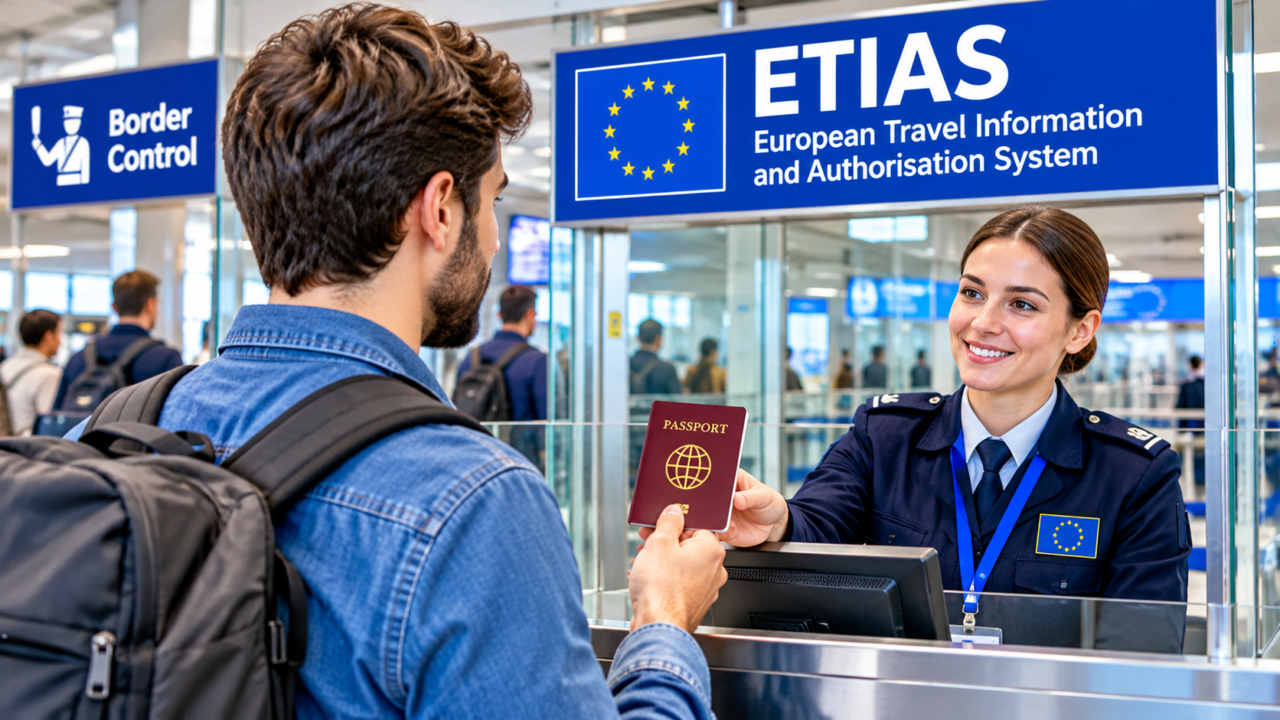
ETIAS is Europe’s new travel authorisation for visitors who do not need a visa, including travellers from the USA, the UK and Canada. It is not a visa, but once it starts you will need an approved ETIAS before you travel to most European countries.
There is a lot of confusing and outdated information online. Some websites still show old prices and dates, and some even try to sell applications before the system is open. This guide explains what it really is, its current status, who needs it, the cost, how to apply when it opens and how it works together with Europe’s new Entry/Exit System (EES).
ETIAS at a glance
- What it is: an online travel authorisation, not a visa
- Who needs it: visa-exempt visitors, including US, UK and Canadian citizens
- Where: 30 European countries, including the Schengen Area and Cyprus
- Fee: €20, paid only by travellers aged 18 to 70
- Valid for: 3 years or until your passport expires
- Status: not yet operating, so there is nothing to apply for today
What Is ETIAS?
ETIAS stands for the European Travel Information and Authorisation System. It is a pre-travel security check for people who can visit Europe without a visa.
The idea is similar to the US ESTA, Canada’s eTA and the UK ETA. Before your trip, you will fill in a short online form with your passport details and answer a few security questions. Most applications are expected to be approved quickly.
The new system does not change how long you can stay. Visa-exempt visitors can still stay up to 90 days in any 180-day period in the Schengen Area for tourism, business or family visits.
Why Is Europe Introducing These Systems?
The EU says the new systems will make borders safer and more efficient. Before EES, officers had to check passport stamps by hand to work out how long a visitor had stayed, which was slow and easy to get wrong.
With digital records, overstays are easier to spot, identity fraud is harder and border checks can become faster over time. ETIAS adds a security check before travel, so possible problems can be found before a traveller boards a plane, ship or train. Many other countries, including the USA, Canada, Australia and the UK, already use similar pre-travel systems, so Europe is following a common international approach to managing visitors.
Is ETIAS Required Right Now?
No. The system is not yet operating, and applications are not open. The European Union has said it will announce the exact start date several months before launch.
Earlier official information pointed to a start in the last quarter of 2026, but the EU has not confirmed a firm launch date. Until the official start date is announced, you can travel to Europe as usual with a valid passport.
Important: if a website asks you to pay for it today, be very careful. The official system is not open yet, so any payment now is not a real application.
Who Needs ETIAS?
Once it starts, the authorisation will be required for citizens of around 60 visa-exempt countries, including:
- United States
- United Kingdom
- Canada
- Australia and New Zealand
- Japan, South Korea and many countries in Latin America
Children also need their own authorisation, even though they do not pay the fee. You do not need ETIAS if you are an EU citizen, if you hold a residence permit for a European country, or if you already need a Schengen visa to visit.
Which Countries Will Require ETIAS?
The system will cover 30 European countries. These include the 29 countries of the Schengen Area plus Cyprus.
| Region | Countries |
|---|---|
| Western Europe | France, Belgium, Netherlands, Luxembourg, Germany, Austria, Switzerland, Liechtenstein |
| Southern Europe | Spain, Portugal, Italy, Malta, Greece, Slovenia, Croatia, Cyprus |
| Northern Europe | Denmark, Sweden, Norway, Finland, Iceland |
| Central and Eastern Europe | Poland, Czechia, Slovakia, Hungary, Estonia, Latvia, Lithuania, Romania, Bulgaria |
Note for UK travellers: Ireland is not part of ETIAS, and the UK has its own ETA system for visitors coming to Britain.
How Much Does ETIAS Cost?
The fee is €20 per application. Travellers under 18 and over 70 do not pay the fee, but they still need an approved authorisation.
An approved authorisation will be valid for three years or until your passport expires, whichever comes first. During that time you can make as many short trips as you like, as long as you follow the 90/180-day rule.
You may still see the old price of €7 on some websites. That figure is out of date, so always check the official site for the current fee.
How to Apply for ETIAS (When It Opens)
- Wait for the official launch: the EU will publish the start date in advance.
- Use only the official website or app: apply through the official EU channel to avoid extra charges.
- Prepare your passport: make sure it is valid for your whole trip and beyond.
- Fill in the form: enter your personal details, passport information, contact details and answers to background questions.
- Pay the fee: pay €20 by card if you are aged 18 to 70.
- Get your decision: most decisions are expected quickly, but some applications may take longer if extra checks are needed.
Your authorisation will be linked electronically to your passport. If you get a new passport, you will need to apply again.
What Is the Entry/Exit System (EES)?
The Entry/Exit System is a separate new border system that is already in use. It became fully operational on 10 April 2026 after a phased start in October 2025.
EES replaces passport stamps for non-EU visitors with a digital record. On your first entry, border officers or self-service kiosks will scan your passport, take your fingerprints and a facial photo, and record the date and place you enter and leave.
You do not need to apply for EES in advance. You simply register at the border the first time you arrive. Your record is then used on future trips, which should make later border checks faster.
What Happens at the Border Under EES
On your first trip after EES started, you will register your details at the border. At many airports you can use a self-service kiosk to scan your passport and answer a few questions, and then a border officer completes the check.
The process usually includes a passport scan, a facial photo and fingerprints for travellers aged 12 and over. Children under 12 are not fingerprinted, but their details and photo are recorded. Once you are registered, later trips should be faster because your data is already in the system for a set period.
When you leave Europe, your exit is also recorded. This digital record replaces the old passport stamps, so you will no longer see new stamps in your passport when you visit Schengen countries.
How Long Will Approval Take?
The EU expects most applications to be processed within minutes. Some applications may need more checks, which can take several days, and in rare cases the authorities may ask for extra information or an interview.
For this reason, it is wise to apply a few weeks before your trip once ETIAS is live, rather than waiting until the day before your flight. Apply before you book non-refundable tours if your trip is close.
Tips for Families
- Every family member needs their own authorisation, including babies and children.
- Parents or guardians can complete applications for children.
- Children under 18 do not pay the fee, which keeps costs low for families.
- Keep all approval emails together in one folder on your phone.
- At the border, children under 12 do not give fingerprints under EES, but they still go through the check with you.
Tips for Business Travellers
Business travellers who visit Europe often should keep a careful record of their trips, because EES counts every day automatically. Short meetings, conferences and site visits all count towards the 90/180-day limit.
Once ETIAS starts, frequent travellers will benefit from its three-year validity, because one approval covers many trips. Companies should add the new rules to their travel policies and remind staff to apply only through the official channel.
Travelling by Train, Ferry and Car
The new rules apply at all external Schengen borders, not only at airports. If you travel from the UK by Eurostar, ferry or Eurotunnel, border checks take place before departure, and queues can be longer during busy periods while travellers register under EES.
Inside the Schengen Area, there are normally no border checks when you travel between countries by train or car, although some countries carry out temporary checks. Always carry your passport, because you may be asked for it at any time.
Other Documents You May Need
Border officers can ask for more than your passport. It is a good idea to carry proof of where you are staying, your return or onward ticket and evidence that you have enough money for your trip.
Travel insurance is not usually required for visa-exempt visitors, but it is strongly recommended. It can cover medical costs, cancellations and lost luggage, which can be very expensive in Europe.
ETIAS vs EES: What Is the Difference?
| ETIAS | EES | |
|---|---|---|
| What it is | Online travel authorisation | Digital border registration |
| When you do it | Online, before you travel | At the border, when you arrive |
| Cost | €20 (ages 18 to 70) | Free |
| Status in 2026 | Not yet operating | Fully operational since 10 April 2026 |
| Data collected | Personal, passport and travel details | Fingerprints, facial image and entry/exit dates |
ETIAS for US Travellers
Americans can visit Europe without a visa today and will still be visa-exempt after the system starts. The only change is the extra online authorisation before travel.
If you are planning a European trip for after the official launch date, add the authorisation to your checklist, just like checking your passport expiry date. US citizens are used to similar systems, because visitors to the USA from visa-exempt countries need ESTA.
ETIAS for UK Travellers
Since Brexit, British citizens are treated as non-EU visitors in the Schengen Area. This means UK travellers will need ETIAS once it starts, and they are already part of the EES system at the border.
If you travel from Dover, Folkestone or London St Pancras, EES checks take place before you leave the UK. Allow extra time, especially during school holidays.
ETIAS for Canadian Travellers
Canadians can also visit Europe without a visa and will need the authorisation after launch. If you hold dual citizenship with an EU country, you can enter with your EU passport and will not need it.
Canadians who fly to the UK also need a UK ETA, which is a separate system from ETIAS.
What Could Cause an ETIAS Refusal?
Most travellers will be approved quickly. An application may be refused if information is incorrect or incomplete, if the passport is reported lost or stolen, or if security or immigration checks raise a concern.
If your application is refused, you will receive the reason and information about how to appeal. You may also be able to apply for a visa instead.
How to Avoid ETIAS Scams
- Apply only through the official EU website or official app once the system opens.
- Do not pay anyone before the official launch date.
- Be careful with sites that look official but charge much more than €20.
- Never share passport details on websites you do not trust.
- Check the address of the website carefully before entering payment details.
The official EU travel information is available on the official ETIAS website, and details about EES are on the official EES website.
The 90/180-Day Rule Explained
The authorisation does not give you more time in Europe. Visa-exempt visitors can stay up to 90 days in any rolling 180-day period across the Schengen countries combined.
This means you count back 180 days from any date of your stay, and the total days you spent in the Schengen Area during that time must not be more than 90. Because EES now records your entries and exits digitally, overstays are much easier for border officers to see, so plan carefully if you take several trips a year.
ETIAS Checklist for Your Next Europe Trip
- Check that your passport is valid for at least three months after you plan to leave Europe and was issued within the last ten years.
- Check whether the system has officially started before your travel date.
- If it has, apply on the official website a few weeks before your trip.
- Expect to register fingerprints and a photo under EES on your first entry.
- Allow extra time at border control, especially at busy airports and ports.
- Count your days to stay within the 90/180-day rule.
Planning a Trip to Europe in 2026 and Beyond
New rules should not stop you from visiting Europe. EES is already working, and the new authorisation will be a simple online step once it opens. For most travellers, the process will take only a few minutes.
The best advice is simple: keep an eye on official announcements, apply only through official channels and leave a little extra time at the border. With good preparation, your Europe trip will be just as easy as before.
Common Mistakes to Avoid
- Paying on unofficial websites before the system opens.
- Believing ETIAS is a visa. It is a travel authorisation.
- Forgetting that children need their own authorisation.
- Applying with a passport that will expire soon.
- Confusing ETIAS with the UK ETA. They are different systems.
- Not leaving extra time for EES checks at the border.
Frequently Asked Questions
Do I need ETIAS to travel to Europe now?
No. ETIAS is not yet operating. You can travel with a valid passport until the EU announces and starts the system.
When will ETIAS start?
The EU has not confirmed a firm date. It has said it will announce the start date several months before launch, so check the official ETIAS website before you travel.
How much is ETIAS?
The fee is €20. Travellers under 18 and over 70 do not pay, but they still need approval.
How long is ETIAS valid?
An approval is valid for three years or until your passport expires, whichever comes first.
Do UK citizens need ETIAS?
Yes. Once the system starts, UK citizens will need it to visit the Schengen countries and Cyprus for short stays.
Is ETIAS the same as a Schengen visa?
No. A Schengen visa is for people who are not visa-exempt. ETIAS is a simpler online authorisation for visa-exempt visitors.
Final Thoughts
ETIAS is coming, but there is no need to panic. Right now, there is nothing to apply for. When the EU confirms the start date, the process will be quick, cheap and fully online.
Bookmark this guide, check official updates before your next trip and enjoy planning your European adventure with confidence. We will keep this page updated as soon as the EU confirms new dates or rules.
Planning a trip? Explore our Europe travel guides, read our tips for finding cheap flights or visit the TourVister home page.




1 comment